Blog

.svg)
Founded in Singapore in 1990, Positive Design grew from modest local projects into a regional retail interior design company working with global luxury brands. It carved out a niche in an industry where precision, reliability and long-term relationships matter as much as what shoppers eventually see in malls.
.webp)
SINGAPORE, August 2026 — Walk into a luxury boutique in Singapore, Bangkok or any city in Asia, and attention naturally falls on the brand: the lighting, displays, materials and carefully presented products. What’s less visible are the companies responsible for turning those carefully planned designs into stores ready to welcome customers.
Behind a completed luxury store can be months of design development, engineering, prototyping, sourcing, fabrication, logistics and installation, involving teams and suppliers across multiple locations.
Singapore-founded Positive Design has spent more than three decades working within this largely unseen industry. Established in 1990, the retail interior design and shopfitting company grew from modest local projects into increasingly complex luxury retail work before expanding its capabilities across the region.
When Positive Design was established, Singapore's retail interior and shopfitting industry was still in its early stages. Its founder, Mr David Soh, saw a need for contractors that could offer quality workmanship together with dependable service, clear communication and a commitment to meeting client expectations.
The company did not begin as a luxury retail specialist. Instead, it built its experience through smaller projects, gradually earning opportunities to undertake more complex work. Those projects exposed the team to the exacting requirements of luxury retail, where seemingly small details can affect how a global brand is presented to its customers.
Positive Design found that these requirements aligned with the capabilities it had been developing: attentive service, reliable execution and the ability to translate detailed design requirements into high-quality finished environments. Over time, luxury retail interior design became one of the company's core specialisations.
To a shopper, a newly opened boutique may appear polished and effortless. Behind the scenes, the process is considerably more complicated.
A project can involve months of coordination across design development, engineering, prototyping, material sourcing, fabrication, logistics, permits and installation, all working towards a fixed opening date.
Luxury retail adds another layer of expectation. Fixtures, materials and finishes have to reflect established brand standards, while the completed store must remain consistent with how that brand presents itself in other markets.
“What many people don't see is the amount of work that happens before a store opens,” Positive Design’s Senior Project Manager, Ayesa Angeles, said. “Our team often works behind the scenes, solving problems before clients even become aware of them.”
Much of that work is invisible by design. When the coordination is done well, shoppers see only the finished environment, not the technical challenges, last-minute adjustments or months of planning that made it possible.
“Success in our business isn't just about building beautiful retail spaces; it's about making complex projects look effortless.”
Positive Design's move beyond Singapore into the wider Asian region was similarly gradual.
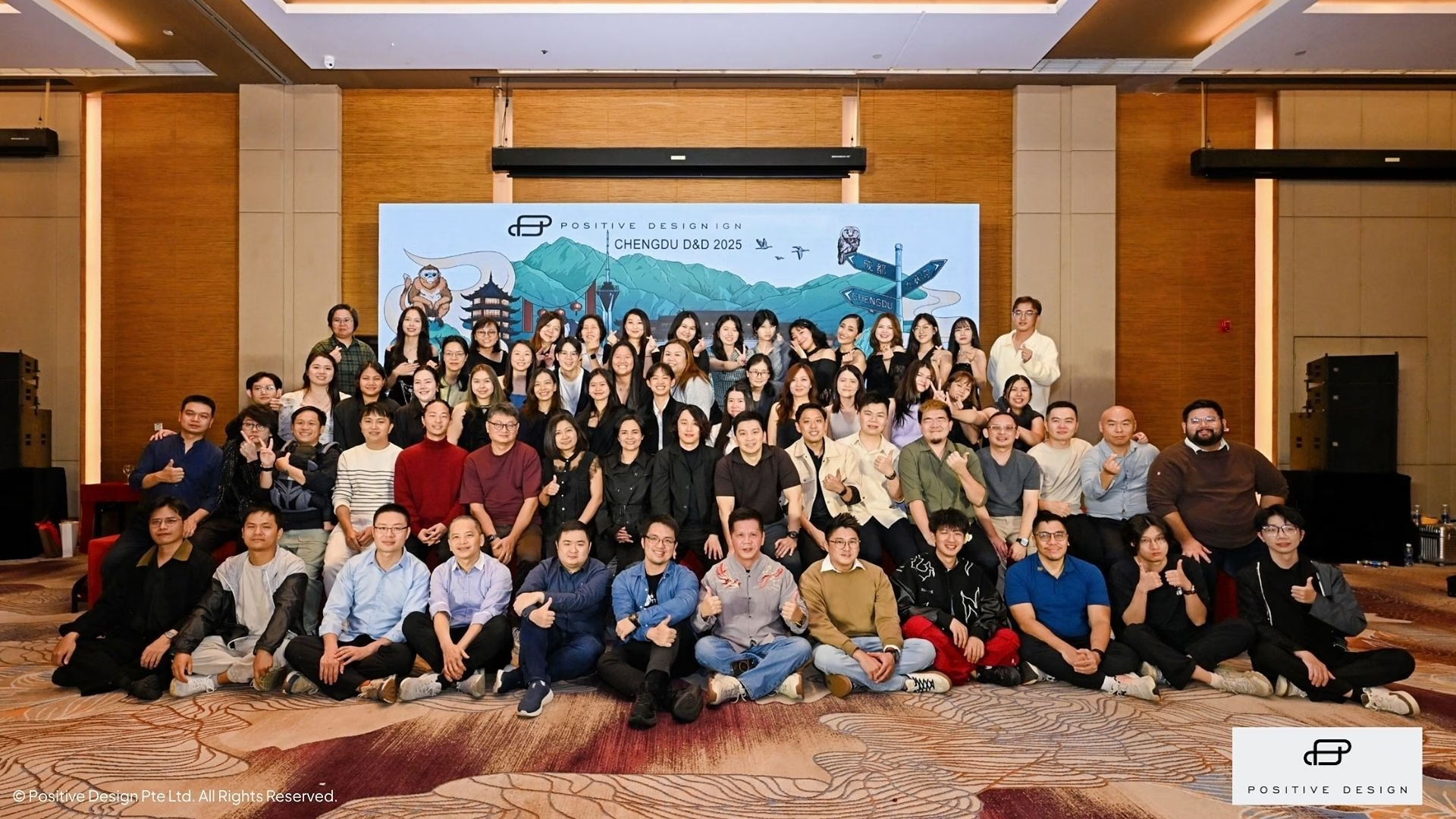
One of the clearest turning points came from the growth of its Bangkok operation. During its early years in Thailand, the company worked from a small shared office with a local team of four to five people. As business developed, the operation expanded. Growth accelerated in the years before the Covid-19 pandemic, with the Bangkok team eventually exceeding 15 employees and moving into its own office.
The expanded team gave Positive Design greater capacity to support projects around the region, with Bangkok developing into an important location for its regional operations.
For a business working with international brands, regionalisation meant more than completing projects overseas. It also required the ability to coordinate different markets, suppliers, contractors and working cultures while maintaining consistent project standards.
Regional growth has also brought greater competition.
The years 2024 and 2025 marked one of the more challenging periods in Positive Design’s history. As the luxury retail market slowed, global brands became more cautious with spending. Some store openings were reduced or delayed, refurbishment plans were postponed and project budgets tightened. At the same time, material, labour and logistics costs were rising, while competition from lower-cost manufacturers, particularly from China, intensified.
Rather than trying to compete purely on price, Positive Design continued to focus on quality, technical expertise, project execution and after-sales support.
An earlier project had already demonstrated why the distinction could matter. A client had initially awarded a retail counter project to another supplier after Positive Design's quotation appeared more expensive. When the completed installation fell short of the quality expected, the client subsequently approached Positive Design to rectify it.
Because the company could coordinate the engineering, fabrication and installation within the same process, its team was able to identify the problems, propose solutions and restore the fixture to the required standard.
The experience reinforced a principle that would become increasingly important as price competition intensified: the initial project cost is only one part of the value equation when the finished environment represents a luxury brand.
Behind Positive Design’s growth are relationships that have developed alongside the company over decades.
Many team members have been with the company for more than 10 or 20 years, while some relationships extend close to 30 years. Positive Design also works with long-standing external vendors that have grown alongside the business. This continuity brings practical benefits to complex projects.
Project managers, designers, production teams and trusted vendors who have worked together for years are already familiar with each other’s working styles, strengths and expectations. This shared understanding helps them coordinate efficiently and respond quickly when unexpected issues arise or deadlines tighten.
“We see our external vendors as an extension of our own team,” Jasmine Cragg, Project & Finance Executive at Positive Design said. “Strong relationships cannot be built overnight. They are earned through consistency, respect and doing what we say we'll do.”
Positive Design sees its Singapore roots reflected less in a particular design aesthetic and more in how its projects are managed.
Planning, clear communication, transparency and accountability are qualities the company identifies with its working culture. These become particularly important when projects involve regional brand teams, designers, contractors, factories and suppliers operating across different countries.
“Clients often tell us they appreciate our responsiveness, professionalism and reliability,” Positive Design’s Account Director, Mindy Hang, said. “As a Singapore company working across Asia, we also understand how to bridge different markets and cultures. Whether we're coordinating with regional brand teams, local contractors or overseas factories, we focus on making complex projects feel straightforward for our clients.”
For luxury brands, that coordination matters because a store ultimately needs to feel like part of the same brand whether the customer encounters it in Singapore or elsewhere in the region.
The industry Positive Design entered in 1990 continues to change.
In the coming years, expectations will continue to evolve. Brands are expected to demand shorter lead times, greater flexibility and more sustainable solutions without lowering expectations around quality. Technology is also becoming more prominent, from digital elements within stores to smarter project management and manufacturing processes.
Sustainability presents another shift. Industry observers such as WorldGBC have highlighted the carbon emissions and construction waste associated with retail fit-outs, while global luxury groups such as LVMH and Kering have introduced environmental and social requirements that extend to suppliers and business partners. In view of these developments, Positive Design has invested in initiatives including its EcoVadis assessment and a partnership with CleanHub. The company expects sustainability to increasingly become a basic requirement for doing business rather than just a point of differentiation.
Its longer-term ambition reflects the same evolution that took it from modest Singapore projects into luxury retail: to move beyond being viewed simply as a shopfitter and become a regional project partner capable of helping brands execute consistently across multiple Asian markets.
More than three decades after it started in Singapore, finding a place in luxury retail has not been about a single breakthrough project. It has been a gradual accumulation of capabilities, relationships and trust. Staying there will require the same willingness to evolve.
Positive Design Pte. Ltd. is a Singapore-founded retail interior design and shopfitting company established in 1990. Luxury retail interior design is one of its core specialisations, and the company works with international brands across Asia.
Luxury retail projects typically involve exacting requirements around craftsmanship, brand consistency and technical execution. They can also require extensive coordination between brand teams, designers, contractors, manufacturers and other stakeholders across different markets.
Positive Design was founded in Singapore and has developed a regional footprint supporting projects across Asia. Today, Positive Design maintains offices and manufacturing facilities across Thailand, China, Malaysia, and Vietnam.
.webp)
Let us breathe new life into your retail environment. Contact us to discuss your vision, or learn about our Turnkey Solutions for a fully integrated approach.